


By Christopher Delp, MD, Medical Director, Duluth Med Spa. In practice since 1992.
Last reviewed: July 2026
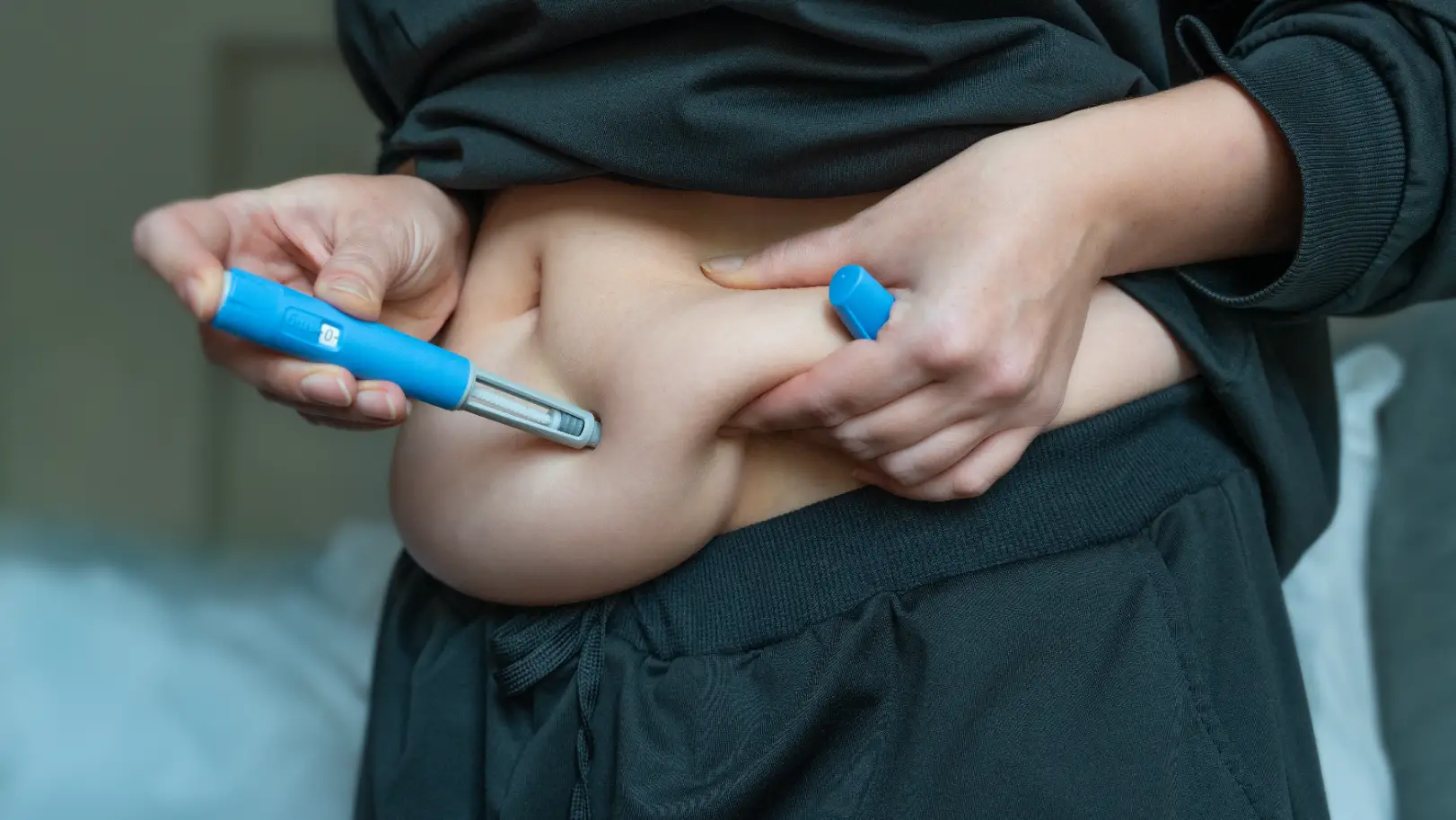
You lost the weight. The scale moved. And now there is skin that did not move with it.
This is one of the most common things patients bring to us, and it is one of the least honestly discussed topics in aesthetics. Most clinics will tell you a device can fix it. Sometimes that is true. Often it is not. Here is the real version.
Why does GLP-1 weight loss cause loose skin?
Fat leaves faster than skin can retract.
Skin that stretched to accommodate more volume needs time and collagen to shrink back. When the loss is rapid, and GLP-1 weight loss is rapid, the skin does not get that time. In the clinical trials, semaglutide produced an average of about 15 percent body weight loss, and tirzepatide produced up to about 22.5 percent. That is a substantial change to the frame underneath the skin, happening over roughly a year.
Several things determine how your skin responds:
– How much weight you lost, and how fast
– Your age, since collagen and elastin production slow over time
– How long you carried the weight
– Sun damage
– Genetics
– How much lean mass you lost along with the fat, since muscle provides the structure underneath
That last point matters more than most people realize. When you lose muscle along with fat, you lose the scaffolding that fills the skin out.
What is “Ozempic face”?
It is two different problems that show up together.
The first is volume loss. Your face has distinct fat compartments, in the cheeks and temples especially. When you lose weight quickly, those compartments deflate. The result is a hollowed, drawn look that reads as aged even when the skin itself is fine.
The second is actual skin laxity, where the skin no longer conforms to the smaller structure beneath it.
These need different treatments. Volume loss is a biostimulator problem. Laxity is an energy device or surgical problem. Telling them apart is the first thing we do at a consultation, because treating the wrong one wastes your money.
Worth saying plainly: this is not a drug side effect. It is a consequence of rapid fat loss and it happens with any rapid weight loss, including bariatric surgery. The medication is not doing something to your face. The weight loss is.
Biostimulators: rebuilding what the weight loss took
This is the treatment we recommend most often to GLP-1 patients, and the one most people have never heard of.
Biostimulators are not fillers in the way most people think of fillers. A traditional filler adds volume by occupying space. A biostimulator prompts your own body to build new collagen over time. The result develops gradually and it is your tissue, not a gel sitting under your skin.
We use two, and they do different jobs.
Sculptra (poly-L-lactic acid)
Sculptra works gradually, stimulating collagen production over several months. It is well suited to the diffuse, overall deflation that follows rapid weight loss, where the problem is not one hollow spot but a general loss of fullness and skin quality. Results build slowly and look like you did not have anything done, which is usually the goal.
Radiesse (calcium hydroxylapatite)
Radiesse provides immediate structural support and then stimulates collagen over the following months. It is useful where you need lift and definition, along the jawline and midface especially, and where a patient wants to see something happen sooner.
Both can be used on the face and both can be used on the body.
That second point matters for GLP-1 patients. Diluted, these products are used to improve skin quality and texture on the arms, abdomen, chest, and neck, which are exactly the areas where rapid weight loss shows. They will not tighten a large amount of loose skin, but they meaningfully improve the crepey, thin, deflated quality of skin that has recently lost the volume underneath it.
For most GLP-1 patients, the right plan is a biostimulator to rebuild collagen and volume, plus an energy device to address laxity. They are not competing options. They solve different halves of the same problem.
What can energy devices actually do?
Here is where most clinics oversell. We are going to be specific instead.
Radiofrequency
RF heats the deeper layers of skin, causing immediate collagen contraction followed by new collagen production over the following weeks and months. It genuinely improves mild to moderate laxity and skin quality. It works best on skin that has some elasticity left to work with.
Microfocused ultrasound (Ultherapy Prime)
This delivers energy at three depths, reaching down to the same tissue layer a surgeon addresses in a facelift. It is FDA-cleared to lift the brow, lift the neck and under the chin, and improve lines on the décolleté. As of November 2025, it also carries FDA clearance for improving skin laxity on the arms and abdomen. It is the most targeted lifting tool we have that does not involve a scalpel.
CO2 laser resurfacing
CO2 is exceptional for skin texture, tone, fine lines, and scarring. It does produce some tightening, because collagen contracts when heated. But that tightening is measured in millimeters. CO2 will improve the quality of your skin. It will not remove excess skin.
Venus Bliss Max
This is a body contouring platform. Its laser applicators are FDA-cleared for non-invasive fat reduction in the abdomen, flanks, back, and thighs, and it includes muscle stimulation. It reduces focal fat and tones muscle. It is a sculpting tool, not a skin removal tool.
Used together with biostimulators, these treat a real and common problem: the patient who has mild to moderate laxity, wants improvement, and does not want surgery.
What can any of this not do?
None of it removes skin.
The FDA says this directly: non-invasive body contouring procedures do not remove any tissue from the body, which is what separates them from a procedure like a tummy tuck that cuts excess skin out. Biostimulators do not remove skin either. They improve its quality and rebuild what is underneath it.
If you have skin that hangs, folds over on itself, causes rashes or hygiene problems, or that you can gather in your hand, that is a surgical problem. No amount of radiofrequency, ultrasound, laser, or collagen stimulation will fix it, and any clinic that tells you otherwise is selling you something that will not work.
In patients who have lost very large amounts of weight, roughly a third have skin that will not contract on its own and will not respond adequately to non-surgical treatment. Those patients need excisional surgery: abdominoplasty, an arm lift, a thigh lift, or a body lift.
We will tell you which category you are in. If you need a surgeon, we will say so and refer you. We would rather lose the sale than take your money for a treatment that cannot deliver.
When should I start? During weight loss or after?
Earlier than most people think, and this is where biostimulators change the math.
Because biostimulators work by building collagen over months, starting them during your weight loss means your skin is rebuilding its support structure at the same time the volume underneath it is disappearing. You are not waiting for a problem to fully develop and then trying to reverse it. You are getting ahead of it.
This is the single most useful piece of timing advice we give GLP-1 patients, and almost nobody hears it soon enough.
Definitive contouring, and especially surgery, should still wait until your weight is stable. Surgeons generally want to see weight held steady for several months before operating, because if your weight moves again the result moves with it. This matters particularly with GLP-1 medications, since a significant portion of the weight can return if the medication is stopped.
The practical answer for most people: start biostimulators and collagen support early, address laxity with energy devices as the picture becomes clear, and decide on surgery only once you have stabilized.
How do we measure whether it is working?
With a 3D body scan, not a bathroom scale.
We use Styku, which captures your body’s circumferences and volume in about 35 seconds using an infrared camera and a rotating platform. It measures inches and volume objectively and repeatably, so we can put a real before and after next to each other rather than asking you to squint at a photo.
We scan at baseline, and at completion for anyone doing a body contouring package.
What we would actually recommend
At your consultation we will tell you three things:
– Whether your issue is volume loss, skin laxity, residual fat, or some combination, because most GLP-1 patients have more than one
– Whether it is within reach of what we have, or whether it needs a surgeon
– What realistic improvement looks like, in plain terms, with a number attached where we can
If you are still losing weight, the conversation usually starts with biostimulators. If you have stabilized and the issue is laxity, it usually starts with energy devices. Most people end up doing some of both.
Biostimulators, skin tightening, and body contouring are in-person treatments. They are available to patients who can see us in Duluth. They are not part of our telehealth program.
If you are on a GLP-1 with us and this is on your mind, bring it up at your next aesthetics visit. The earlier we look at it, the more options you have.
References
U.S. Food and Drug Administration, Non-Invasive Body Contouring Technologies
American Society of Plastic Surgeons, Body Contouring After Major Weight Loss
https://www.plasticsurgery.org/cosmetic-procedures/body-contouring
American Society of Plastic Surgeons, How Plastic Surgery Can Address “Ozempic Face”
https://www.plasticsurgery.org/news/articles/how-plastic-surgery-can-address-ozempic-face
Wegovy (semaglutide) prescribing information, DailyMed
https://dailymed.nlm.nih.gov/dailymed/drugInfo.cfm?setid=f5e548d0-cc79-4c34-a3f5-e20a5b8b6564
Zepbound (tirzepatide) prescribing information, DailyMed
https://dailymed.nlm.nih.gov/dailymed/drugInfo.cfm?setid=487cd7e7-434c-4925-99fa-aa80b1cc776b
This information is educational and is not a substitute for medical advice. Individual results vary. Not everyone is a candidate for every treatment.
4.
Title tag: GLP-1 Side Effects and How to Manage Them | Semaglutide & Tirzepatide | National Telehealth
Meta description: Nausea, constipation, fatigue, muscle loss. What the FDA labels actually report, what works to manage it, and when to call your provider.
GLP-1 Side Effects and How to Manage Them
By Christopher Delp, MD, Medical Director, Duluth Med Spa. In practice since 1992.
Last reviewed: July 2026
Most people on a GLP-1 medication will have some side effects. Most of those side effects are gastrointestinal, most show up during dose increases, and most improve with time and adjustment. Very few people need to stop the medication.
Here is what the clinical trials actually found, what we do about it, and what is worth a phone call.
What are the most common side effects?
In the FDA-approved labeling for Wegovy (semaglutide), adults in the weight management trials reported:
– Nausea: 44 percent, compared with 16 percent on placebo
– Diarrhea: 30 percent, compared with 16 percent
– Vomiting: 24 percent, compared with 6 percent
– Constipation: 24 percent, compared with 11 percent
In the labeling for Zepbound (tirzepatide), rates varied by dose:
– Nausea: 25 to 29 percent
– Diarrhea: 19 to 23 percent
– Vomiting: 8 to 13 percent
– Constipation: 11 to 17 percent
Other reported effects include abdominal pain, indigestion, fatigue, burping, injection site reactions, and hair thinning.
Two things are worth pulling out of those numbers. First, side effects are common, so if you are having them, you are not unusual and you are not doing anything wrong. Second, most are mild to moderate and they ease over time.
Why do these medications cause nausea?
GLP-1 medications slow how quickly your stomach empties and act on appetite signaling in the brain. That is the mechanism that makes them work. Nausea is the same mechanism turned up too high, too fast.
That is a useful way to think about it. Nausea is not a sign that something is wrong. It is usually a signal that your dose went up faster than your body was ready for.
What actually works to manage side effects?
Dose titration is the single most effective tool we have. Not an anti-nausea prescription. Not a supplement. The dose.
The medications come with a standard escalation schedule, but that schedule is a starting point, not a requirement. If you are struggling at a given dose, we can hold you there longer or step you back down. Going slower does not mean failing. It means finding the dose your body tolerates.
Beyond dosing, the things that actually help:
For nausea and vomiting
– Eat smaller meals, more often
– Stop eating at the first sign of fullness, not when you feel full
– Avoid fried and high-fat foods, which empty from the stomach slowly to begin with
– Limit alcohol and carbonated drinks
– Stay hydrated, at least 1.5 liters of fluid daily
For constipation
– Increase fiber gradually
– Increase fluids
– A stool softener or a gentle laxative when needed
– Movement, even a daily walk
For fatigue
– Usually a sign of eating too little, not of the medication itself
– Protein at every meal
– Do not skip meals because you are not hungry
If those measures are not enough, we can discuss anti-nausea medication. But we reach for the dose first, because that treats the cause rather than the symptom.
What about muscle loss?
This is a real issue and it does not get enough attention.
When you lose weight on a GLP-1, some of what you lose is lean mass, not just fat. A meta-analysis of nine randomized trials published in Obesity found that lean mass accounted for roughly 31 percent of total weight lost, averaging about 2.5 kilograms. Across studies the range runs from about 25 to 40 percent.
Some lean mass loss happens with any weight loss. But it is not something to shrug at, and it is largely preventable.
Two things protect muscle:
– Protein. Aim for roughly 1.2 to 1.6 grams per kilogram of body weight per day. For most adults that is meaningfully more protein than they were eating before. When appetite drops, protein is the first thing people stop eating, and it is the last thing they should.
– Resistance training. At least twice a week. This does not mean a gym membership and a program. It means loading your muscles against resistance regularly enough that your body has a reason to keep them.
This is also why we recommend body composition tracking rather than relying on the scale alone. The scale tells you that a number went down. It does not tell you what you lost. Our Styku 3D body scans measure circumference and volume objectively, so we can see whether the weight coming off is the weight you wanted to lose.
What are the serious risks?
Both semaglutide and tirzepatide carry a boxed warning. In rodent studies, these medications caused thyroid C-cell tumors, including medullary thyroid carcinoma. Whether they do this in humans is not known. Both medications are contraindicated if you or a family member has had medullary thyroid carcinoma or Multiple Endocrine Neoplasia syndrome type 2.
The labels also describe less common but serious risks:
– Acute pancreatitis
– Gallbladder disease. In the Wegovy trials, gallstones were reported in 1.6 percent of patients compared with 0.7 percent on placebo
– Acute kidney injury, usually from dehydration caused by vomiting or diarrhea
– Low blood sugar, particularly if you also take insulin or a sulfonylurea
One update worth knowing: the FDA investigated reports of suicidal thoughts in patients taking GLP-1 medications and, after a comprehensive review, found no evidence of a causal link and requested removal of that warning from the labels. The European Medicines Agency reached the same conclusion.
When should I call?
Call us, or seek care, for any of the following:
– Severe or persistent abdominal pain, especially pain that radiates to your back
– Pain in the upper right abdomen with fever or yellowing of the skin or eyes
– Vomiting that will not stop, or signs of dehydration including very little urine output
– A lump in your neck, hoarseness, or trouble swallowing
– Any sign of a severe allergic reaction
Do not stop the medication on your own outside of an emergency. Call first. In most cases the answer is a dose adjustment, not stopping.
The honest summary
Side effects are common. Serious side effects are not. The most common reason people quit a GLP-1 is not danger, it is discomfort that could have been managed with a slower dose escalation and better support.
That is what a physician-supervised program is for. If you are struggling, tell us. Adjusting the plan is not a failure of the plan.
References
Wegovy (semaglutide) prescribing information, DailyMed
https://dailymed.nlm.nih.gov/dailymed/drugInfo.cfm?setid=f5e548d0-cc79-4c34-a3f5-e20a5b8b6564
Zepbound (tirzepatide) prescribing information, DailyMed
https://dailymed.nlm.nih.gov/dailymed/drugInfo.cfm?setid=487cd7e7-434c-4925-99fa-aa80b1cc776b
FDA request for removal of suicidal behavior and ideation warning from GLP-1 labeling
National Institute of Diabetes and Digestive and Kidney Diseases, Prescription Medications to Treat Overweight and Obesity
This information is educational and is not a substitute for medical advice. Individual results and side effects vary. Talk to your provider about your specific situation.


